Calibration Drift in AI Resume Scoring Models Over Time
Models trained on yesterday's hiring patterns fail to recognize today's qualified candidates.

AI resume scoring models can keep producing orderly scores after their definition of a qualified candidate has become outdated. Calibration drift is the widening gap between that learned definition and current hiring conditions. Responsible AI-assisted hiring therefore depends on ongoing checks against human judgment and the live applicant pool.
How AI resume scoring systems work and what they are actually optimizing for
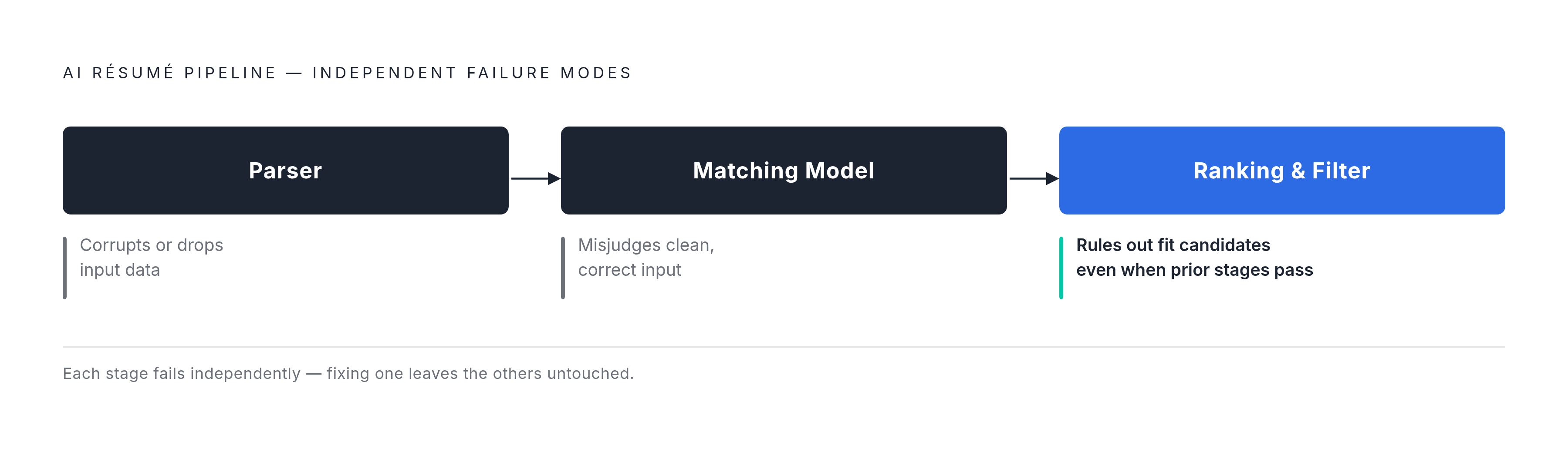
Most deployed resume-scoring pipelines combine at least three components, which are a parsing engine, a matching model, and a ranking or filtering layer. The parser converts resume documents into structured fields. The matching model scores those fields based on how well they match a job description. The final layer turns scores into a shortlist, often through a threshold that determines which candidates advance.
Each layer can fail independently, with different consequences for the candidate. A misparse corrupts the information available for evaluation, while a poorly calibrated matching model misjudges information it has received correctly. A badly set threshold can then rule out suitable candidates even when the earlier stages work as they should. Beneath these distinctions lies a common limit. The model optimizes a learned approximation of “qualified” derived from historical hiring decisions and training data.
Why the snapshot the model was trained on becomes wrong over time
That approximation encodes the conditions under which the training data was produced. Calibration drift occurs when the relationship between resume features and qualification changes in the real world while the model’s weights remain fixed. In this setting, it is a form of concept drift. The software can continue operating without a visible error even as its scores become systematically wrong. The failure is a mismatch between the model’s reference point and the market.
The labor market continuously changes that reference point. Job titles emerge, skill terminology evolves, and demand patterns shift. A model trained on what a “senior engineer” looks like at one point may therefore encode a different qualification target from the one employers need a few years later. The title can remain familiar while the meaning attached to it changes.
Language drift creates a further gap between evidence and interpretation. New phrases enter use, existing terms change meaning, and candidates change how they describe their work. An embedding-based scorer trained before a terminology shift can assign low similarity to current phrasing even when the underlying skills match. Most deployed models are not retrained as frequently as these changes occur, so their training distribution increasingly diverges from the live applicant pool.
A new drift vector: what happens when AI writes the resumes the screener is scoring
AI-assisted resume writing changes the applicant population in another way. Screeners trained before its widespread use now see more documents written in a style that differs from what they were trained on. This is not simply the arrival of new skill names. It changes the form in which candidates present otherwise comparable qualifications. As a result, the scorer must interpret a shifting relationship between writing style and evidence of ability.
Xu, Li, and Jiang’s August 2025 research found that LLMs consistently preferred resumes generated by themselves over resumes written by humans or alternative models. The researchers found this self-preference bias against human-written resumes in major commercial and open-source models. Their simulations across multiple occupations showed that candidates using the same LLM as the evaluator were substantially more likely to be shortlisted than equally qualified applicants submitting human-written resumes. The largest disadvantages appeared in business-related fields, including sales, accounting, and finance.
This preference creates a feedback loop in which the evaluator rewards stylistic proximity to its own output. Scores can stay consistent with one another while becoming less useful for judging how qualified a candidate is. Where organizations also layer an AI-authorship detector onto screening, they introduce another system whose calibration may differ from the scorer’s. That organizational dynamic matters without assuming any particular platform has native detection features. Adding an assessment of authorship does not, by itself, establish whether the hiring assessment is sound.
Golo Henseke and colleagues’ research using nine LLM raters provides a separate caution about model choice. Their labor-market annotation study found pairwise rank correlations ranging from 0.74 to 0.92, while aggregate exposure levels varied much more widely. This illustrates a relevant distinction between agreement on ordering and agreement on score levels. Similar rankings do not make raters interchangeable. In hiring, that distinction matters whenever a score becomes a filtering decision.
Drift does not affect all candidates equally, and the gap widens as models age
Models trained on historically biased hiring decisions can encode those decisions as their baseline. As the reference distribution recedes from current applicants, drift can amplify existing bias by increasing the disadvantage faced by groups whose representation was already thin or skewed. It affects who gets considered as well as how far average accuracy falls.
Wilson & Caliskan’s AIES 2024 research found that language-model-based resume rankers preferred white-associated names in a large majority of paired comparisons. Black male names won zero of their head-to-head comparisons against white male names. Stanford, UC Berkeley, and Oxford researchers found in October 2025 that AI resume-screening tools gave older male candidates higher ratings than both female candidates and younger candidates. All candidates’ resumes in that research were generated from the same underlying data.
Those studies identify unequal starting conditions from which drift can compound harm. A model already relying on skewed associations has no inherent reason to correct them when terminology, candidate writing, or labor-market demand changes. Some candidates may become harder for it to recognize as qualified while others remain close to its learned reference. An aggregate performance measure can obscure that unequal loss of recognition.
What Mobley v. Workday reveals about who is legally responsible when a drifted model causes harm
Mobley v. Workday, Inc. places responsibility for automated hiring decisions before the courts. In the N.D. Cal. case, lead plaintiff Derek Mobley, who is Black, over 40, and has anxiety and depression, alleges rejection across numerous applications to companies using Workday’s platform. He alleges that automated rejection emails often arrived within an hour of applying or in the middle of the night. The tools’ alleged bias and any role of calibration drift in his rejections remain unproven. The case matters here because it addresses accountability for screening performed on an employer’s behalf.
The ADEA class was conditionally certified on May 16, 2025, and the scope expanded to include HiredScore AI features on July 7, 2025. On June 22, 2026, Judge Rita F. Lin ruled that the core discrimination claims can go ahead. Workday has not been found liable on the merits, and the core litigation continues. The legal trajectory establishes that an AI tool screening candidates on an employer’s behalf can be treated as the employer’s agent. That principle makes it harder to place all the responsibility on either the software supplier or the employer.
A January 2026 class action against Eightfold AI raises a related question about how applicant data is gathered and used. It alleges that the company operated as a consumer reporting agency by collecting and scoring applicant data from unverified third-party sources without consent, in violation of the Fair Credit Reporting Act. That allegation shows that scrutiny can extend to both the data feeding candidate assessments and their final scores.
California’s regulations, which took effect October 1, 2025, make clear how existing anti-discrimination law applies to AI hiring tools. New York City’s local law on automated employment decision tools requires independent annual bias audits and candidate notification. EU AI Act Annex III classifies recruitment screening as high-risk, with a compliance deadline of December 2, 2027 under the AI Omnibus. Existing discrimination, privacy, and labor obligations do not pause because an AI-specific deadline moved.
Why calibration drift is so hard to detect from inside the system
A drifting model can remain coherent on its own terms. Standard performance monitoring may show that a pipeline works without showing that its scores still reflect the qualifications needed now. Self-preference exposes this distinction particularly clearly. A model can apply a stylistic preference consistently, making its behavior look stable even though the preference is irrelevant to candidate merit. Internal consistency is therefore not an independent test of validity.
Diagnosis becomes harder because different layers can produce similar downstream exclusions. Retraining the matching model does not repair a broken parser, and repairing the parser does not correct concept drift in the model. Without separating these causes, an intervention can leave the source of harm untouched. Vendor opacity adds another obstacle when meaningful technical documentation, empirical evidence of fairness improvements, or clear definitions of bias mitigation are unavailable. A claim that a system mitigates bias is not enough to establish what was measured or whether it remains true.
Evidence across model generations also complicates any claim that harm must worsen uniformly. Golo Henseke and colleagues’ nine-rater research found no general upward drift in exposure levels across generations. Within one vendor’s lineage, mean exposure fell across generations, suggesting that newer versions may reduce some calibration problems without explicit retraining. That result shows how labor-market exposure ratings changed but does not directly show that hiring became fairer. It shows why neither deterioration nor correction should be inferred from a model’s release order alone.
Structural drift means that the relationship between a fixed assessment and a changing world requires ongoing validation. Some changes may reduce a disparity, while others may leave it untouched or alter a different part of the assessment. To resolve that uncertainty, organizations need evidence tied to the hiring task and the candidates actually being evaluated.
A practical framework for detecting and correcting calibration drift before it causes systematic harm
Drift detection should operate as an ongoing discipline. Trigger-based monitoring provides a starting point by tracking false-reject rates over time, disaggregated by candidate demographic signals. A rising false-reject rate within a subgroup requires attention when changes in the applicant pool do not explain it. The purpose is to identify fairness drift before exclusions accumulate into systematic harm. A stable overall rate cannot substitute for that subgroup assessment.
Parsing needs its own audit because checks at the scoring layer cannot reliably reveal when the parser has corrupted the input. Non-standard formats, AI-generated templates, and evolving PDF structures are persistent sources of parsing failures. The corrective response must follow the diagnosis rather than treat every poor outcome as a model-training problem. Separately, organizations should from time to time re-score a held-out set of human-reviewed resumes against current job descriptions. Checking the resulting rank order against expert judgment tests whether the model still recognizes who is qualified for jobs as they are now.
Vendor accountability makes those checks more meaningful. Organizations should require disclosure of the training data vintage, the retraining schedule, and the definitions used for bias mitigation. Vague claims and proprietary scoring mechanisms that resist external auditing are governance red flags. These requirements connect responsibility to information that can support an assessment. They also make clear that purchasing a scoring tool does not settle the question of its continuing fitness for use.
The same standard applies when organizations build or augment engineering teams, including through nearshore staff augmentation partners. Any AI-assisted evaluation step remains subject to the same gap between a learned snapshot and current hiring needs. People who understand the current market should set the vetting standard. The model can assist that judgment, but unknown calibration cannot replace it. Responsible hiring depends on detecting when the score has stopped measuring what the organization needs it to measure.
Sources
- Nine Raters, One Index: Carrying LLM Disagreement into Labour-Market Estimates
- American Journal of Data Science and Analytics, August 2026, 01-33 1
- Fairness Is Not Enough: Auditing Competence and Intersectional Bias in AI-powered Resume Screening
- Federal Court Allows Collective Action Lawsuit Over Alleged AI Hiring Bias
- Help Wanted, Screened by Algorithms: Mobley v. Workday and the Legal Limits of AI Hiring
- Mobley v. Workday: Court Holds AI Service Providers Could Be Directly Liable for Employment Discrimination Under “Agent” Theory
- FAIRE: Assessing Racial and Gender Bias in AI-Driven Resume Evaluations