Diversity Sourcing Strategies Beyond Job Board Postings
Reaching passive talent requires intentional sourcing channels, not job board habits.

The default hiring strategy at most companies is not a strategy. It's a habit. Post the role, wait for applications, filter the stack, move the most credentialed candidates forward. The problem is structural. Job boards surface active seekers, people already looking, already visible, already inside every other company's funnel at the same moment. The engineers building the most interesting things, leading technical communities, and contributing to open-source projects at a high level are frequently not refreshing LinkedIn. They're working. Reaching them requires deliberate channel selection, not passive posting. According to SelectSoftware Reviews data from 2024, 78% of employees say workplace diversity influences where they consider working, yet only 22% of companies are actively building DEI into their hiring pipelines. That gap is not a values problem. It's a sourcing methodology problem.
What's actually at stake when the talent pool stays narrow
The business case for diverse hiring is no longer a matter of advocacy; it's empirical. McKinsey's 2020 research found that companies in the top quartile for ethnic and cultural diversity were 36% more likely to outperform peers on profitability. Diverse teams make better decisions 87% of the time. These are not aspirational figures. They describe a compounding competitive disadvantage for organizations that build from a narrow pool.
The narrowness is not evenly distributed. Recruiting benchmarks from Gem show that female candidates were 2.4 times less likely to receive recruiter outreach than male applicants. That asymmetry doesn't emerge from neutral processes. It emerges from passive pipelines that inherit the skews of whatever channels feed them. If the channel is biased toward a certain kind of active seeker, the pipeline will be biased before a single hiring decision is made.
The cost compounds further downstream. Teams assembled from a restricted demographic range miss the perspectives that shape product decisions for diverse user bases, reduce churn risk by reflecting the customers they serve, and fail to open market segments that require genuine cultural fluency to address. This is the competitive case, independent of equity considerations.
That the problem is solvable at scale is already documented. Deloitte set an explicit target of a 50% increase in Black and Hispanic/Latinx professionals in US teams by 2025, and surpassed it at 54.2% two years ahead of schedule. The mechanism was not goodwill. It was intentional sourcing, goal-setting, and measurement. The lesson is operational, not inspirational.
How university partnerships reach engineers before they enter the open market
HBCUs, Hispanic-Serving Institutions, tribal colleges, and women's colleges are structured access points to underrepresented engineering talent. They're also chronically underutilized by companies that define "university recruiting" as sending a representative to a career fair once per semester.
Presence at a career fair is not partnership. Genuine access comes earlier and runs deeper — guest lectures that put technical leaders in front of students before graduation, mentorship programs that create relationships over semesters rather than afternoons, and competitions that let your team evaluate students' work directly. These interactions build institutional trust that a branded booth can't replicate. Faculty begin flagging strong students proactively. Alumni refer peers. The institution becomes a recurring pipeline rather than a one-time visit.
Geography matters here in ways that domestic job boards can't capture. A growing number of technically strong engineers are graduating from universities in Latin America, and they won't appear on a North American job board without deliberate outreach. The region has produced a rapidly maturing engineering talent base with strong English proficiency in technical fields and timezone alignment with North American teams. These are not secondary considerations. They're precisely the characteristics that make a sourcing channel valuable, and this one remains underutilized by most hiring teams.
The compounding effect of sustained university relationships is difficult to overstate. Each cohort of hired graduates becomes a referral network for the next. That self-sustaining quality is the structural advantage that differentiates a sourcing program from a series of one-off recruiting events.
Community organizations and professional networks that job boards never reach
Organizations like Techqueria, which serves Latinx professionals in tech, and Out in Tech, which serves LGBTQ+ technology professionals, concentrate communities that are professionally active and technically accomplished. Many of their members aren't scanning mainstream job boards — not because they're disengaged from the labor market, but because their primary professional community exists elsewhere. Treating these organizations as posting boards misunderstands the relationship entirely.
Local nonprofits and workforce development programs occupy a particularly valuable position in the sourcing ecosystem. They often know skilled candidates before those candidates have begun a job search. Partnering with them early creates first-mover access that no reactive posting strategy can replicate.
Employee resource groups inside other organizations are an underused referral channel. Members maintain peer networks across the industry, and those networks carry implicit endorsement in a way that cold outreach can't. A referral from a trusted peer in a professional community is a qualitatively different signal than an inbound application from a job board.
The sourcing dynamic in these channels is fundamentally different from posting and waiting. It requires showing up consistently, contributing to events, sponsoring programming, and engaging with the community's actual priorities before broadcasting an open role. Trust is the entry fee. These networks have seen enough extractive recruiting, companies that appear when they're hiring and disappear afterward, to be appropriately skeptical. Investment precedes access. There's no shortcut.
Open-source projects and niche developer communities as talent signals
Open-source contribution is public, searchable, and skill-revealing in ways a résumé can't replicate. A commit history documents problem-solving approach, code quality, and collaboration under scrutiny. A résumé documents what a candidate claims. The distinction matters, and it's exploitable by any recruiter willing to look.
Engineers from underrepresented groups who contribute substantively to open-source projects or lead specialized technical forums are frequently invisible to recruiters who search only standard profile platforms. The work is visible. The channel used to find it is simply not part of most sourcing workflows.
Niche communities, specialized Slack groups, Discord servers, GitHub organizations, domain-specific forums, concentrate talent around a technical problem rather than around a hiring process. Engineers self-select into these spaces based on genuine interest and capability. Identifying the communities relevant to your hiring needs, participating in them before recruiting, and engaging contributors based on the quality of their work is a higher-signal approach than most companies practice.
This channel also surfaces engineers in non-traditional geographies. Contributors to major open-source projects are distributed across Latin America, Africa, and Southeast Asia in significant numbers, well outside the markets any domestic job board addresses.
One limitation deserves acknowledgment: not every underrepresented engineer has the discretionary time to build a visible open-source profile. The channel is more accessible to engineers who aren't carrying disproportionate caregiving or financial burdens, which correlates with certain demographic groups in ways that aren't neutral. Open-source sourcing should supplement other channels, rather than replace them.
Conferences and events designed for underrepresented communities in tech
General technology conferences draw a general attendee mix. Events organized specifically for underrepresented groups, including conferences focused on women in engineering, Black technologists, and Latinx developers, concentrate precisely the talent that default pipelines miss. Attendance at these events is a minimum, not a strategy by itself.
Sponsorship, speaking slots, and workshop participation signal genuine engagement rather than transactional recruiting. A company that sponsors a conference for Black technologists one year and disappears the next communicates more clearly through that absence than through any job description language about belonging.
The practical advantage of event sourcing over cold outreach is that passive candidates are more accessible in event settings. A conversation initiated in a professional context carries warmth that an unsolicited LinkedIn message structurally can't. This matters because the candidates most valuable for diversity sourcing are frequently not active seekers and are accordingly less responsive to cold contact.
Regional and local events deserve as much attention as national conferences. Engineers in mid-sized cities and emerging tech markets are active at local meetups and aren't on the radar of companies that attend only marquee national events. Virtual events have expanded the geographic reach of this channel meaningfully, particularly for teams prepared to hire remotely or build relationships in markets like Latin America.
Remote work as a geography-based diversity channel
A hiring requirement tied to a commuting radius around a single office is a structural filter. It eliminates most of what the previous channels can provide before the sourcing conversation begins. The geography of historical tech employment concentration, coastal US metros primarily, is not a neutral geography. It reflects patterns of investment, infrastructure, and access that systematically underrepresent the engineers this piece is describing.
Cities with larger populations of underrepresented groups show meaningfully higher interest in remote work. Research cited in DEI hiring literature has documented this pattern in markets like Detroit and Atlanta, where interest in remote roles runs measurably above national averages. Remote roles attract a more diverse applicant pool from these markets. This isn't coincidental; it reflects where engineers live when they haven't self-selected into high-cost coastal metros.
International remote hiring, particularly in Latin America, extends access to engineering talent that is timezone-compatible with North American teams and culturally aligned with collaborative working norms. These candidates don't require relocation. They require that a company be willing to hire them where they are.
A remote-first posture also sends a signal that engineers from historically filtered-out geographies interpret correctly — this company is genuinely open to where I live. That signal reaches candidates who have learned, through experience, to discount stated commitments to inclusion that are quietly contradicted by location requirements. Communicating the posture, however, requires that roles be posted and promoted through the community and institutional channels described earlier. The geography strategy and the community strategy aren't separate. They reinforce each other.
How pipeline management keeps diverse candidates from disappearing after sourcing
Sourcing without pipeline management produces point-in-time results. A candidate engaged at a conference in October is a missed hire by February if no one has maintained contact. The goal is a living database of candidates organized by skill set, sourced from the channels described above, and maintained with enough engagement that the company remains visible to candidates who aren't yet in an active job search.
Passive candidates sourced from communities and events require ongoing relationship maintenance — newsletters, event invitations, periodic updates about the company's technical direction. The cadence should be consistent without being intrusive. The purpose is presence, not pressure.
Speed matters operationally. Passive candidates who enter an active process are often simultaneously fielding approaches from multiple companies. Moving quickly when a role opens prevents candidates from accepting competing offers during the gap between initial contact and a formal process. Slow pipelines lose the candidates they worked hardest to source.
Outreach language and job description framing function as informal filters. Credential-heavy requirements, specific degree mandates, and institutional signals that favor traditional career paths systematically disadvantage candidates from non-traditional backgrounds, regardless of technical capability. Skills-focused language consistently outperforms this framing in both reach and conversion.
Structured interviews assess candidates against defined criteria, reducing the influence of subjective "cultural fit" judgments that disproportionately disadvantage candidates sourced from non-traditional channels. The sourcing effort is wasted if the evaluation process reintroduces the same biases the sourcing strategy was designed to circumvent. AI-assisted screening tools from providers like HireVue, Pymetrics, and Eightfold.ai can evaluate candidates on demonstrated competencies rather than institutional signals, which is genuinely useful for candidates from non-traditional backgrounds. These tools require active bias auditing to ensure the training data doesn't encode the same skews the sourcing strategy is trying to correct.
Metrics that distinguish a functioning diversity sourcing program from activity theater
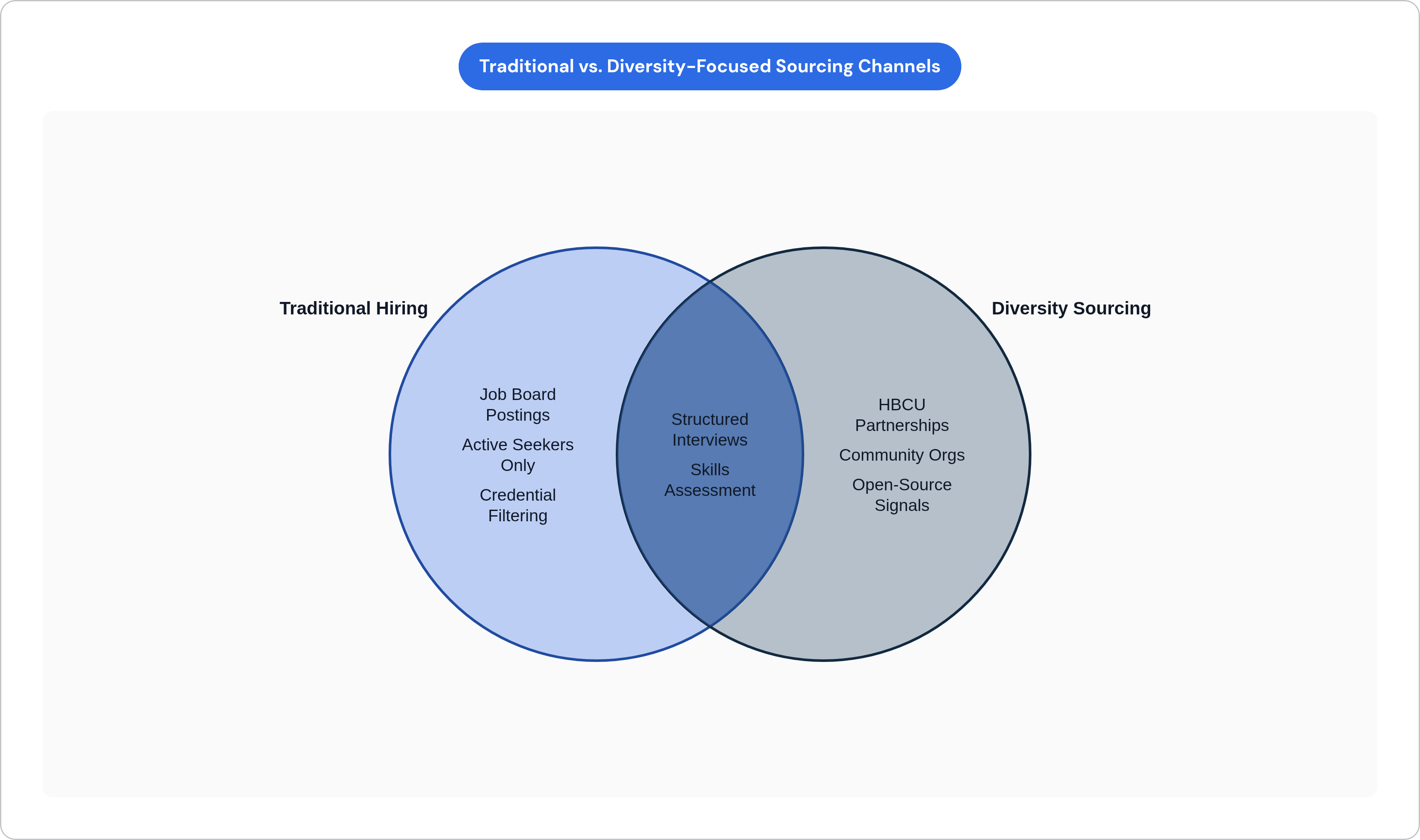
Most organizations measure diversity at the hire stage. That measurement arrives too late to be actionable and too aggregated to be diagnostic. Without channel-level tracking, there's no way to know which investments are producing results and which are producing the appearance of effort.
Four metrics provide a functioning foundation. The Diversity Sourcing Ratio measures what percentage of candidates entered the pipeline from diversity-focused channels. It identifies whether the sourcing investment is actually generating pipeline or simply generating activity reports. The Diversity Interview Ratio measures what percentage of underrepresented candidates sourced from those channels advance to interviews, revealing where drop-off occurs before a hire decision is ever made. Offer Acceptance Rate by Demographics identifies whether the offer and the culture signal lands differently across groups, which is often the first measurable indicator of a larger retention problem. Retention Rate of Diverse Hires is the downstream test of the entire strategy; sourcing that finds candidates who leave within eighteen months hasn't solved the problem.
Salesforce's targeted mentorship and recruitment initiatives produced a 24% increase in employee satisfaction among underrepresented groups by 2024. That's a retention metric, not a sourcing metric, and it points to the connection between intentional hiring and what happens after the offer is signed. The Deloitte result, 54.2% increase in Black and Hispanic/Latinx professionals ahead of a stated target, was produced by explicit goals. Measurement without a stated target produces neither accountability nor urgency.
The operational discipline required here is identical to what any competent team applies to a sales funnel or a marketing channel. Set a sourcing ratio target by channel. Review it quarterly. Cut investment from channels that aren't moving the ratio. This isn't complicated. It requires only the willingness to apply the same rigor to sourcing that most organizations already apply to everything else.