Technology Sector Investment Trends in Latin American Startup Ecosystems
Latin American funding is recovering, but only for disciplined, proven companies.

Latin America’s technology investment recovery rewards a different kind of startup than the 2021 boom did. Capital now favors operational discipline, governance, and businesses tied to concrete economic demand. Founders and engineering leaders need to understand that shift because their ability to deliver plays a growing role in whether they can raise funding.
Why Latin America's investment rebound looks different from the 2021 boom
Rising funding totals suggest renewed confidence, yet falling deal counts show how narrowly that confidence is distributed. Cuantico VP’s report places deal volume at its lowest level since 2017 even as total capital climbed. Across hundreds of rounds in 2025, fewer companies received more money on average, with most of the capital going to proven businesses. Investors are scrutinizing execution rather than treating a compelling growth narrative as sufficient grounds for a check.
That distinction changes what a recovery means for an individual company. In 2021, investors often bet on stories of future growth, while today they put more weight on governance and proof of how a business runs. Access remains uneven. The strongest alternative interpretation, that any rebound signals a return to broad investor optimism, misses this separation between the amount invested and the number of companies receiving it.
Where the capital is actually going: sectors and stages driving the 2025–2026 numbers
Fintech accounted for 61% of total VC capital in 2025 and an outsized share of deals. SaaS occupied a steady secondary position, extending the investment profile these two sectors have defined for several consecutive years. AI-native businesses are also among those drawing the most capital, while clean energy is becoming a third focus for investors. The sector map is concentrated. It combines established software and financial services categories with newer investment interest in AI and asset-linked energy businesses.
The stage map is more divided still. Seed and angel funding surged in Q3 2026, rising sharply against both the prior quarter and the year-earlier period. Early-stage funding, defined here as Series A/B, contracted over those same intervals. At the same time, larger checks into proven companies make up a growing share of the money invested. A startup’s chances of raising money depend on both how well its sector is doing and how much funding is available at its stage.
The structural forces behind the capital shift: nearshoring, fintech infrastructure, and clean energy tailwinds
Nearshoring helps explain why supply-chain and cross-border payments startups are drawing interest in Mexico and northern Latin America. Their opportunity connects to economic activity moving across borders, rather than depending only on a forecast of future consumer adoption. Within fintech, stablecoins and cross-border payment infrastructure are the latest areas to draw investors’ interest. The intended market is changing as well. Founders are building for global customers from the outset instead of primarily adapting foreign models to local consumers, giving investors a different basis for assessing potential scale.
Chile’s Black Giant lithium project and Colombia’s Erco Energía solar infrastructure are tied to physical assets and offtake contracts, with resource endowments and regulatory frameworks shaping the opportunity. These are not interchangeable software growth stories. Their investment cases depend on specific economic foundations. In parallel, regional banks and legacy institutions are turning to third-party AI platforms for credit scoring and risk management. That creates a B2B revenue channel for AI-native startups, linking the venture thesis to institutional demand.
Mexico overtaking Brazil: what the geographic shift actually signals
Mexico’s lead over Brazil in cumulative 2026 funding reflects a few large deals supported by nearshoring proximity. Brazil retains greater deal breadth, exit depth, and institutional investor coverage. Totals and depth are different measures here.
Brazil attracted Sequoia, Founders Fund, NEA, Battery, and Tidemark in the past year, with several making their first LATAM investment or their first in a long time. Individual rounds reinforce the distinction. Kesh Bank raised a substantial equity and debt seed round in August 2026, while Decade secured the largest seed round ever for a LATAM startup, illustrating Brazil’s deal quality and AI-native ambition. Beyond those two countries, Erco Energía and Black Giant show investment geography broadening into Colombia and Chile. Those examples indicate additional depth, though not yet a structural rebalancing.
What investors are now requiring from founders before writing checks
Investors now want structured boards, clean cap tables, and defensible unit economics before they put money into growth-stage rounds. Governance is a condition of access. Founders who survived the 2022–2024 correction through internal bridge rounds developed these habits by necessity, while many early-stage founders are not yet positioned to meet the same expectations. They also want capital efficiency and a clear path to growing the business across borders. For engineering leaders working with startups, this means delivery plans are being assessed within a broader test of how well the business uses and controls capital.
Market positioning faces a similarly exacting test. Founders targeting international customers from inception are more attractive than those adapting established models only for local markets, where the addressable opportunity is more constrained. Geography alone is an insufficient investment thesis. International allocators compare LATAM companies with global peers in AI, fintech infrastructure, and clean tech, making technical specificity central to the pitch. A company presented simply as “LATAM fintech” competes within a commoditized frame. Its founders need a distinct technical angle and operating evidence.
The Series A gap and why the seed surge does not automatically resolve it
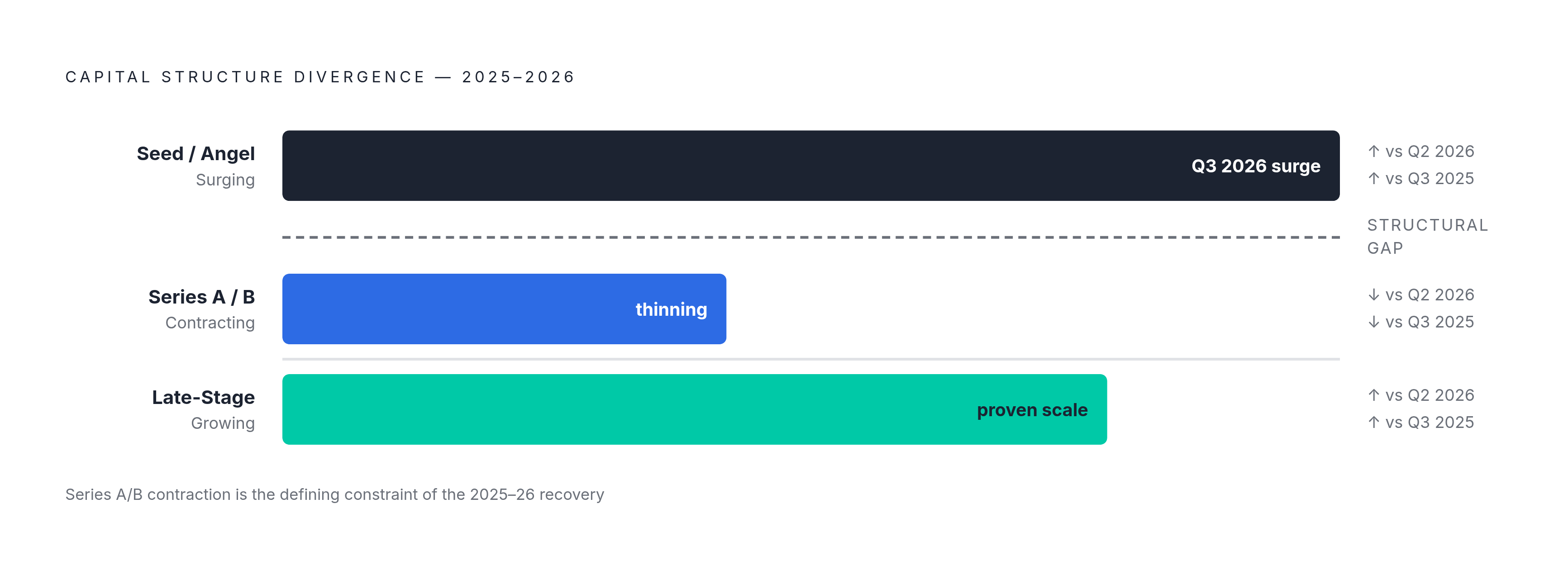
The simultaneous seed surge and Series A/B contraction create a bottleneck between initial financing and growth capital. Larger late-stage investments absorb an increasing share of available dollars, leaving a thinly funded middle layer for companies that already have real traction. More seed deals create a larger cohort that may eventually need access to that layer. The resulting constraint is structural rather than simply a pause in enthusiasm, because the distribution of capital favors entry and proven scale more than the transition between them.
Improving liquidity offers some relief, but for a different group. Endeavor Catalyst’s Piquet points to dozens of private Latin American technology companies that have each raised large amounts of venture capital and could form an IPO pipeline. For now, the exit door is opening through acquisitions and secondary transactions. Those routes benefit LPs and founders who survived the downturn. They do not, by themselves, finance the next generation of Series A candidates. The recovery’s durability therefore depends partly on whether companies can cross this middle stage, rather than remaining funded at seed but unable to secure the capital needed for their next phase.
What the LATAM talent pool brings to execution-focused startups and their engineering partners
The region’s engineering workforce provides an operational asset in a market that rewards efficient delivery. Latin America produces more than 500,000 engineering graduates per year, with Brazil, Mexico, and Colombia leading its large and growing software engineering workforce. Country differences shape the available fit. Brazil has the largest talent pool, Argentina the strongest English proficiency, Mexico the closest timezone alignment to US Pacific and Mountain time, and Colombia strong value on US Eastern time.
Timezone alignment supports collaboration across the US workday when investors, customers, and go-to-market teams are in North America. Engineering cost structures can also extend runway compared with equivalent US-based teams, directly connecting hiring choices to capital efficiency. Cost is only one part of that equation. In an execution-focused business, shared working hours help teams iterate as quickly as investors expect, while production-grade software requires high-quality engineering. BairesDev, a nearshore software development partner, is one option supplying vetted LATAM engineers in North American-aligned time zones to companies building infrastructure associated with nearshoring. Its stated positioning connects the region’s talent base to delivery capacity rather than treating geographic proximity as an end in itself.
How AI-native development is reshaping what LATAM startups can ship and what investors expect
AI-augmented development changes the relationship between team size and output, but its gains are not uniform. The shift toward agentic tools in 2026 increasingly puts engineers in charge of long-running systems of agents handling implementation, while human judgment concentrates on architecture and strategy. Senior engineering work is changing in substance. Faster task completion, however, is not equivalent to an equally large improvement across an entire delivery process. Reported productivity gains vary widely, so investors need to judge what teams can deliver with AI tools rather than assume that using them will improve output.
The cost model also requires closer attention. Inline completion tools have modest monthly costs per engineer, while agentic tools and custom LLM pipelines introduce usage-based token spending that can reach multiples of the base license cost. Seat-only budgets therefore understate the potential expense. At the same time, reliance on AI during junior engineers’ early careers can weaken their ability to validate generated code, putting the region’s training pipeline at risk. That risk sits directly beside the productivity opportunity, because a larger supply of graduates is less useful if teams cannot judge the systems they produce.
Production remains the decisive test for AI-native companies. A working prototype does not establish that a system can withstand real user load, security audits, or changing requirements, and the brief transition from demonstration to dependable software is where many AI features fail. Investors who expect teams to deliver need engineering partners who can make that transition. The operational warning is to measure AI returns honestly, account for usage costs, and preserve the judgment needed to validate AI-written code. Otherwise, work that seems fast can hide weaknesses in both the product and the team that will maintain it.
What engineering leaders and founders should take from this investment cycle
For founders and engineering leaders, the practical implication is to treat engineering decisions as investor-facing decisions. Investors increasingly scrutinize deployment frequency, change failure rates, and security certifications as closely as they do cap tables and unit economics. Technical governance is no longer purely internal. Seed-stage teams also need to build for scalability earlier because the Series A bottleneck makes weak engineering foundations harder to finance through. That changes the balance of risk from a cycle that punished over-engineering toward one that increasingly punishes under-engineering.
Teams should choose engineering partnerships that fit those business needs. Staff augmentation fits defined short-term gaps, dedicated teams support sustained roadmap execution, and end-to-end outsourcing serves defined deliverables. Investment stage and delivery cadence should guide the choice. Nearshoring then gives teams access to AI-ready talent and shared working hours as well as lower staffing costs. Endeavor Catalyst’s Taylor describes the possibility of another “rediscovery moment” for Latin America among global investors. The informational edge belongs to teams that recognize what such attention would reward and can demonstrate operational maturity before a broader return of capital makes the opportunity obvious.